1. Introduction: The Critical Role of Custom Seals
In modern industrial manufacturing, elastomeric seals serve as the ultimate barrier components. A sealing failure can lead to catastrophic equipment downtime, environmental contamination, or safety hazards.
- The Procurement Challenge: Sourcing these vital components requires balancing engineering precision, material compliance, Total Cost of Ownership (TCO), and reliable delivery logistics.
- The Limitation of Standard Parts: While local distributors provide off-the-shelf items, high-performance environments (e.g., extreme temperatures, high pressure, aggressive chemicals) demand specialized engineering and precise compound formulation.
- The Ultimate Solution: Partnering with a top-tier Custom Seals manufacturer ensures that advanced polymer science is integrated seamlessly with high-volume production scale, unlocking zero-defect reliability for North American buyers.
2. Engineering & Custom Manufacturing
Leading manufacturers do not just produce rubber parts; they engineer structural solutions using precise mold tolerances and tailored design capabilities.
Advanced Tooling & Mold Tolerances
- ISO 3302-1 Class E1 Precision: Critical applications (micro-fluidics, aerospace) demand unforgiving tolerances held as tight as $\pm 0.08\text{ mm}$ to ensure consistent squeeze rates and prevent dynamic friction wear.
- CNC EDM Multi-Cavity Tooling: High-precision machining guarantees uniform vulcanization and identical cross-sectional geometry across every cavity in mass production.
- Thermal Shrinkage Compensation: Elite engineers calculate exact linear shrinkage rates ($1.5\%$ to $3.5\%$) of specific compounds and machine these volumetric compensations directly into the raw steel mold.
OEM & ODM Capabilities
- Finite Element Analysis (FEA): Simulates contact pressure distributions and cross-sectional deformation under fluid pressure before cutting physical metal tooling.
- Rapid Functional Prototyping: Single-cavity prototype molds deliver material-accurate elastomeric samples within 7 to 10 days for physical fit testing.
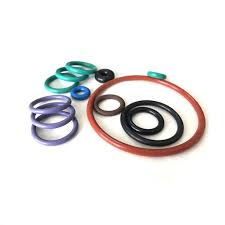
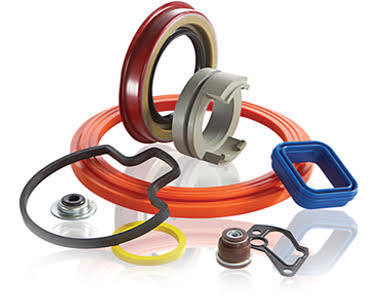
- Complex Profile Geometries: Expertise extends beyond circular O-rings to custom X-rings (Quad-rings), Square-cuts, D-rings, lip seals, and rubber-to-metal bonded components.
Full Customization Scope
- Precision Dimensional Sizing: From $0.5\text{ mm}$ micro-rings to massive mold-cured seals exceeding $2,000\text{ mm}$ for heavy infrastructure.
- Durometer (Hardness) Tuning: Tailored Shore A hardness ranging from ultra-soft $30\text{ Shore A}$ for plastic housings to $90\text{ Shore A}$ for resisting high-pressure extrusion.
- Branding & Color Coding: Chemically stable pigments (blue for EPDM water seals, green for FKM oil seals) prevent assembly mix-ups, alongside custom laser etching for brand identification.
3. Material Science & Compound Formulation
Selecting the appropriate polymer compound requires a scientific understanding of cross-linking density, compression set resistance, and media compatibility.
Elastomer Comparison Matrix
| Elastomer | Temp Range (°C) | Key Strengths | Primary Applications |
| NBR | -30 to +120 | Excellent petroleum oil resistance | Hydraulics, fuel systems |
| FKM | -20 to +230 | Superior chemical, fuel, and heat resistance | Automotive, oil & gas |
| EPDM | -50 to +150 | Outstanding steam, ozone, and UV resistance | Water treatment, HVAC |
| Silicone | -60 to +230 | Broad thermal stability, non-toxic | Food/Beverage, medical |
| FFKM | -15 to +320 | Near-universal chemical resistance | Semiconductor processing |
German-Engineered R&D & Compression Set
- ASTM D395 Method B Standards: Measures an elastomer’s ability to retain its original thickness after compressive strain. A seal that “takes a set” loses radial sealing force and leaks.
- Advanced Vulcanization Chemistry: Utilizing peroxide-cured packages instead of traditional sulfur curing dramatically strengthens molecular bonds, lowering compression set values and extending operational seal life by up to 300%.
Application-Specific Blends
- Water Treatment (NSF/ANSI 61 & WRAS): Specialized chloramine-resistant EPDM blends prevent embrittlement in municipal water lines and pass strict extraction testing for drinking water safety.
- Oil & Gas (ASTM D471 & ISO 23936-2): High-modulus, densely cross-linked FKM compounds are engineered to survive Explosive Decompression (AED) without internal blistering when system pressures drop rapidly.
4. Quality Assurance & Industry Compliance
Top-tier manufacturers maintain an airtight, multi-tier quality control infrastructure to guarantee component reliability.
Rigorous Laboratory Testing
- Rheology and Curing Curves: Moving die rheometers (MDR) ensure no polymer batch is under-cured (causing failure) or over-cured (causing brittleness).
- Tensile Strength (ASTM D412): Verifies the maximum stress the material can endure and its ultimate elongation percentage before fracture.
- Thermal Aging (ASTM D573): Samples are baked in high-temperature ovens for 168 hours to simulate years of field use and verify long-term stability.
Automated Optical Inspection (AOI)
- 100% Defect-Free Sorting: Glass-disc conveyor tables with 360-degree high-resolution cameras instantly scan thousands of parts per minute.
- Micro-Defect Detection: Algorithms identify parting line voids, flash particulate, and out-of-roundness down to $0.02\text{ mm}$, using air jets to eject defective parts and ensure zero-defect delivery.
Global Regulatory Compliance
- FDA CFR 21 177.2600: Certifies rubber articles are non-toxic and sanitary for food and pharmaceutical processing.
- REACH & RoHS: Ensures components are free of restricted heavy metals and hazardous substances.
- ISO 9001:2015: Guarantees complete raw-material-to-finished-product traceability across all manufacturing lines.
5. B2B Procurement Guide: Preventing Failure
Procurement engineers must utilize a technical evaluation method to prevent field failures and optimize overall costs.
Engineering Procurement Checklist
- Application Mechanics: Define if the seal is static or dynamic, and establish maximum operating pressures (including spikes).
- Media & Thermal Extremes: Detail every fluid chemical exposure and pinpoint the absolute minimum and maximum continuous operating temperatures.
- Geometry & Tolerances: Specify if standard AS568 sizing applies or if a custom profile with E1 precision tolerances is required.
Overcoming Common Failure Modes
- Extrusion & Nibbling: High pressure forces soft rubber into metal clearance gaps. Solution: Procure a higher Shore A hardness compound or utilize PTFE Back-Up Rings.
- Spiral Failure: Uneven dynamic friction twists the seal until it tears. Solution: Upgrade to a stable X-Ring (Quad-ring) profile or apply low-friction plasma coatings.
- Chemical Volume Swell: Incompatible fluids cause the seal to expand and lose integrity. Solution: Require strict ASTM D471 immersion testing to keep volumetric swell below $10\%$.
Total Cost of Ownership (TCO)
- Evaluating True Cost: The cheapest piece price is irrelevant if machinery fails in the field. TCO includes initial tooling amortization, assembly scrap rates, and the financial risk of downtime.
- The ROI of Quality: Partnering with the best Custom O-ring manufacturers guarantees low scrap rates ($<0.1\%$ via AOI), durable tooling, and perfect batch consistency, ultimately saving significant operational costs.
6. Bode Dynamic: Factory Strength & Expertise
When evaluating international manufacturing partners, Bode Dynamic (Bode) combines rigorous European technical engineering with massive, efficient manufacturing scale.
Company Heritage & European Synergy
- Established Expertise: The Xiamen manufacturing subsidiary was officially established in 2008 in the logistically advantageous Huli District International Shipping Center.
- German Headquarters R&D: Front-end elastomer formulation and complex mold engineering are driven by German engineers, ensuring all designs strictly adhere to elite DIN standards before execution in Xiamen.
Infrastructure & Scalable Production
- Expert Workforce: Supported by over 100 highly skilled polymer chemists, mold technicians, and quality inspectors.
- Advanced Machinery: The production floor utilizes over 30 state-of-the-art vacuum compression and rapid injection molding machines to eliminate trapped air defects.
- Dedicated Partner Network: Operations are scaled alongside 5 specialized partner factories, isolating distinct technologies (e.g., keeping dirty carbon-black oil seal production separate from clean silicone medical molding).
Specialized Industry Dominance
- Water Treatment Leadership: Unmatched capabilities in engineering chloramine-resistant EPDM and silicone parts that meet stringent drinking water extraction standards.
- Fluid Power & Oil Seals: World-class formulation of FKM and NBR seals capable of surviving explosive decompression, heavy shaft friction, and synthetic hydraulic fluids.
North American B2B Service Model
- Rapid Development: Offers 24-hour DFM feedback on CAD models (STEP, IGES) and 7 to 10-day turnarounds for custom prototype tooling.
- Flexible Customization: Total OEM and ODM support for unique cross-sections, branded color-coding, and custom kitting.
- Optimized Global Logistics: Comprehensive freight management directly from the Xiamen shipping hub to North American manufacturing plants, complete with full batch traceability certificates (3.1 Inspection Certificates, CoA).
By prioritizing engineering capabilities, deep material science, and robust infrastructure, North American procurement leaders can secure components that outlast the competition. Contact the expert engineering team at Bode Dynamic today to discuss your specific working conditions and initiate your custom OEM/ODM sealing project.